Volcanic Rocks, Cinder Cones and Lava Fields
Volcanic eruptions do not happen just anywhere. Several conditions must come together: molten rock below the surface, cracks or weak zones in the crust, and enough pressure to force magma upward. In the Mojave Desert, many volcanic fields are tied to faulting, crustal stretching, and movement along deep zones of weakness. These fractures gave magma a path toward the surface, where it erupted as cinder cones, lava flows, and other volcanic landforms. USGS notes that volcanic rocks are widespread in the Mojave region, including the Cinder Cones and Lava Flows area of Mojave National Preserve.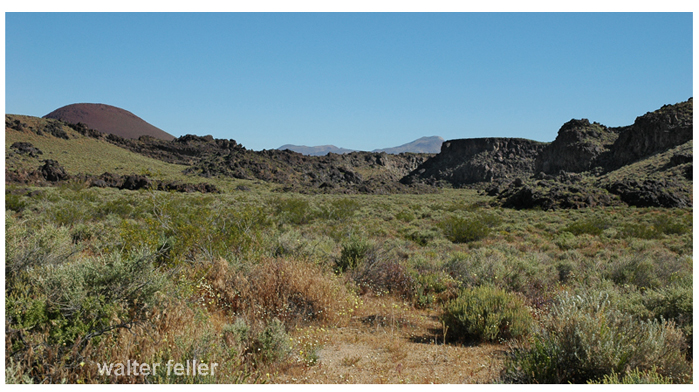
Fossil Falls as viewed from Little Lake
During the Mesozoic Era, western North America was shaped by active plate movement, mountain building, faulting, and volcanism. At that time, oceanic crust of the Farallon Plate was being forced beneath the edge of North America. Much later, beginning about 30 million years ago, large fault systems developed across what is now California and the Basin and Range region. The crust was broken into blocks that shifted, tilted, and stretched.
This block movement created cracks and weak places in the crust. In some areas, hot mantle-derived basaltic magma rose through these fractures. Where the magma reached the surface, it erupted. Where it did not, it cooled underground or remained trapped below the surface.
Cinder cones form during relatively small basaltic eruptions. Gas-rich lava is thrown into the air as blobs, bombs, cinders, and ash. These fragments fall back around the vent and build a steep-sided cone. Some cones also send lava flows across the surrounding desert floor. The National Park Service describes cinder cones as being built mainly of cinders, ash, bombs, and blocks.
In the Mojave Desert, these volcanic features may look young because the dry climate preserves them well. Dark basalt flows, red and black cinder slopes, lava tubes, and rough lava surfaces may remain visible for thousands of years. The Cima volcanic field in Mojave National Preserve has an eruptive history beginning millions of years ago and continuing into very recent geologic time.
The Coso volcanic field, near the Owens Valley and Garlock fault region, is another important volcanic area of the desert margin. It lies east of the Sierra Nevada and is associated with young volcanic rocks, geothermal heat, and active crustal extension.
These cones and lava fields are reminders that the Mojave Desert is not a dead landscape. It is old, dry, and quiet on the surface, but its rocks record deep movement, heat, pressure, and eruption. Faults opened the way, magma rose, and lava spread across the desert floor. What remains today is a hard black record of fire, preserved by time and desert air.
Volcanic eruptions don't occur everywhere. Several "ingredients" must combine at the right place and time.
While geologic complexities of Southern California are still under investigation, many researchers think that faulting, block movement, and associated magma production are key ingredients contributing to the formation of cinder cones and lava flows in the Mojave Desert.
During the Mesozoic Era (~245-65 million years ago), extensive tectonic activity in western North America resulted in a dynamic period of volcanism and faulting as the Pacific Plate began to slide beneath the North American Plate. Then, around 30 million years ago, great fault systems developed further throughout present-day California. Regional movement of these faults cracked the earth's crust into blocks.
As the plates and blocks of the earth's crust slide and rotate, they generate friction and and tremendous heat. Beneath the Mojave, rocks of the lower crust melted. Because it is less dense than the surrounding rock, the melted, mantle-derived basalt or magma, rises toward the surface. When magma cannot find a path upwards it pools into magma chambers. The chambers can be huge, providing enough magma for many volcanos over several years. To form a volcano, however, magma must reach the surface.
The spaces between fault blocks are zones of weakness reaching down to the mantle. Pressure within magma chambers was released as eruptions through such fractures or vents in the earth's crust , providing magma with a way up and out. With this final ingredient, a hot and "fresh" volcano is formed.
adapted from NPS Mojave - Cinder Cones, Lava Flows & Lava Tube